Wednesday, July 11, 2012

Public Private Partnership taking roots in Rungwe:


On 14th June 2012, Rungwe PBF Pilot Project organized a one day meeting for local Government Leaders in the District.  This meeting had two objectives: Introduction of general Concept- Performance Based Financing as health financing model, and secondly to give feedback on project implementation in the District.  It was held at DMO Conference in Tukuyu.
It was attended by the key  Local Government officials from Rungwe District Council: The Chairman of the District Council, the District Executive Director, the Chairman of the Social Services – Rungwe District Council and heads of Departments.
It was officially opening by District Executive Director- Rungwe District Council who noted that: the Council as stakeholder in this project has potential roles: regulate policies, guidelines as set by the Government. He added that EU and Cordaid financing this project in Rungwe has enabled the Public Private Partnership in the District which is quite important. Then he thanked them for their financial support.
He argued the participants to take actively participation in this meeting so as to clearly understand this concept on health financing and apply some of the elements in the District, and get the feedback on the project implementation so as to know what is being done and be in a position to advice the Project for improvement.
After the official opening, Zonal PBF Coordinator made a presentation which was basically divided into two parts: Part one was on the Basic Concept on Performance Based Financing as one of the model in Health care Financing, and the second part was on the feedback for project implementation( showing success, challenges and some recommendations)
As a general impression, the participants were stirred up by the benefits which so far the model will have on the health Care as opposed to traditional health financing model I.e. input based financing which is commonly applied in Tanzania.
The participants objectively discussed ways of improving the Voluntary agency Health facilities especially those at Lower Level- Dispensaries and Health Centres.
Below are some of the proposal for such improvement.
-     - Service agreement with the Local Government, in this case Rungwe District Council.  It was apparent from the discussion that there is no such modality, as these facilities have no trained staff to handle funds from basket fund. However, this proposal was taken as part of the solution for addressing the prevailing shortage of: Drugs, medical supplies and human resource for health. Additionally,, the other side of the agreement was also probed- delay in funds disbursement from the Government was noted as another impediment for making the lower health facilities provide health services to the population. Nevertheless, it was taken as a lesser evil option, and members advised the project team to find out modalities from other Councils in the region which has such experience.
-    The issue of improving relationship for Local Government and Church Leaders was another hot issue. It is worth expressing that, through the District Medical Officer (DMO) of Rungwe District Council, the trained staff have been seconded to the Voluntary Agency Health facilities, but it was learnt that for some reasons, these staff normally take short period before going back to their employer- Rungwe District Council. From October 2011 to date, the District Council has seconded 12 health staff to church Health facilities. We can see that this is the beginning of the collaboration and it is hoped that more support will be availed to the church health facilities which have entered service Agreement with the Local Government.

The participants viewed situation facing church health facilities located mostly in rural areas from objective viewpoint. They raised some solution which will be further worked on for improving health care for the  people in the rural areas.

As a conclusion, we can see that the Collaboration between the  Public and Private Partnership in health care through Rungwe PBF Pilot  is getting more roots and definitely would need support from all parts.

Friday, June 8, 2012

Church Leaders meeting on Rungwe Performance Based Financing (PBF) Pilot Project


Last week on 29th May 2012, Rungwe PBF Pilot Project organized one day meeting for church leaders in Rungwe District specifically those who own health facilities.  Two presentations were made by Zonal PBF Coordinator on Updates of Rungwe PBF Pilot Project and the second one was on Tanzania Human Resource Project (THRP) by Acting Zonal Secretary. The meeting was held at Catholic Youth Centre in Tukuyu township, and 19 members attended who are: The key officers and the heads of departments.
Moreover, the meeting had these objectives:
- Church leaders understand Rungwe PBF Pilot Project
-  Church Leaders updated on Project progress and challenges
-  Finding ways of applying some PBF principles in other Sectors in the church apart from health
- Church leaders understand Tanzania Human Resource Project, its progress and challenges
After all the presentations, the members gave number of comments, but generally were stirred by Performance Based Financing Approach. They indicated that  the approach if well applied in the church will lead to better results and relieve the church from various cost incurred due to business as usual ways of doing things.
However, after the meeting, the members came up with recommendations and way forward. These are:
-  Church leaders further discuss ways of applying some of the principles of Performance based Financing in various institutions,
-  Introduction of performance assessment for the staff in the church, which could also be two way traffic,
- Church to have business plans which would enable them to be more focused in her mission/ Ministry.
- Investment in the Information Technology and consider as a key element in the church organizations to cope with development in the digital age.
This meeting is considered as advocacy platform for church leaders to discuss ways of improving their organizations, which are faced by issues related to performance. Additionally, it is worth expressing that the church leaders considered PBF as one of the instrument to introduce change in church institutions for the benefit of the people they serve. They frankly pointed out challenges for introducing change in the organizational set up, but were positive that with time and commitment they will succeed, and that is really encouraging! Therefore, the meeting was successful. See the group photo during  the meeting.

Tuesday, March 6, 2012

PBF High Level Conference opened in Dar-Es- salaam- Tanzania

The long awaited Performance Based Financing (PBF) high level conference was colorfully opened today by His Excellence Dr. Gharibu Bilali- Vice President of the United Republic of Tanzania at Bank of Tanzania (BOT) Conference.
 The official opening was preceded with key notes from various speakers.  The Executive Director of the Christian Social Services Commission (CSSC) -Mr. Peter Maduki was the first speaker who gave a word of welcome to the conference participants. He gave a brief note of the Christian Social Services Commission (CSSC) as an institution in delivering social services specifically health and education. He further indicated that the Christian Social Services Commission (CSSC) works with the Government in the two sectors in the spirit Public Private Partnership. Furthermore, he officially acknowledged the EU and Cordaid financial support for the Performance Based Financing Project.  Moreover, he thanked members of the multi-country network for choosing Tanzania for this conference.
Then, Director of Cordaid – Mr. Renè Grontenhuis followed by giving a brief note, saying that this Conference is for sharing experience on Performance Based Financing, and for gaining more knowledge on this new health financing model. He argued conference participants to have commitment in improving health services. On top of that he stressed that performance Based Financing (PBF) can contribute to:  strengthening national health System (taking example of Rwanda back in early 2000, later the 7 multi-country network states, Zimbabwe and Afghanistan), empower communities, and clarify roles of different actors in the health sector. Finally, he noted that this Conference is a signal for Performance Based Financing on health care. Eventually, he invited members to share their good experiences and those which are not even so good so that they are used for improvement of ten (10) years of PBF implementation by Cordaid in Africa.
The Minister of Health and Social Welfare (MOHSW) Dr.Hadji Mponda- thanked the participant of the conference who included: Ministers from PBF multi-country network, members from the donor community,the partners from the multi-country network and others for attending this important meeting. He informed the participants that Performance Based Financing (PBF) is becoming popular in health and the Ministry of Health and Social Welfare (MOHSW)is learning it as one of the health financing model. He welcomed the Guest of Honour.
The Guest of Honour- His Excellence Dr. Gharibu Bilali welcomed all the distinguished participants to this conference. He appreciated the initiatives done by Cordaid in funding the Pilot Project on Performance Based Financing in the African Countries- Rwanda, Burundi,DRC and later to the Multi- Country PBF Network comprising seven African Countries.  He pointed that, the Performance Based Financing (PBF) is the health financing Model which shits focus from traditional input based to output based financing. It involves incentivizing the staff and have more accountability at the health facilities.
He spelled out the Conference objectives being:
·        To enable participants to understand the concept of PBF and its impact on the health services utilization, quality of health services, human resources for health, good governance, client satisfaction and  some potential risks.
·        To create awareness to policy decisions as required at different levels, thus improve in the implementation and thus expand the PBF
·        To  create the capacity, on how to assess the (political, economic social) implications of the decentralization and transfer of autonomy
·        To understand and value the role of different stakeholders notably the CSOs.
·        To expand the network to include more stakeholders, as part of an international network with access to experts in the government, donors and CSOs.
He shared with the participants the challenges which might crop as a result of introducing Performance   Based Financing (PBF), which include: the sustainability, staff to temper with the data as they have implication on their rewards, the system is donor dependent at the moment.
Finally, he reminded the conference participants that Performance Based Financing (PBF) is not the magic bullet to boost the health workers performance. He ended his speech by saying that he believed we can move to the next step successfully.
The Arch Bishop Thaddeaus Ruwa’ichi, the Christian Social Services Commission (CSSC) President gave a vote of thanks to the Guest of Honour.  He thanked His Excellency Vice President of United Republic of Tanzania- Dr. Gharibu Bilali, and noted that Tanzania is being honoured by being given the opportunity to organize this conference.  He assured him that, the Christian Social Services Commission (CSSC) will continue to improve quality of health services without any segregation for the betterment of all the people. 
Below is the Group photo - Guest of Hour (in front- at the middle)to the right: Minister for Health-Tanzania,Cordaid Director, Minister for Health Central Africa Republic.To the right : Minister for Health Burundi,CSSC President and CSSC Executive Director and other key officials after official opening.

Monday, March 5, 2012

Cordaid Director Brief Visit to CSSC HQT


The higher Level Conference for PBF is scheduled to be held in Dar-Es-salaam- Tanzania at Bank of Tanzania Conference  from 6th- 7th March 2012. Most of the invited members have arrived for the meeting and amongst them was a Cordaid Director- Mr. Renè Grontenhuis with his delegation.  He had a brief meeting with the Christian Social Services Commission (CSSC) Executive Director- Mr. Peter Maduki and some of the Conference organizing Committee from: CSSC, HDP and Cordiad.
In the brief discussion, the CSSC Executive Director highlighted the historical background of CSSC, the Public private partnership in regard to health service provision, the funding for the CSSC.  Additionally, he expressed the challenges which are prevailing in the Voluntary Agency Hospitals (VAH), though there exist the variation from one local government to the other based on economic capacity.
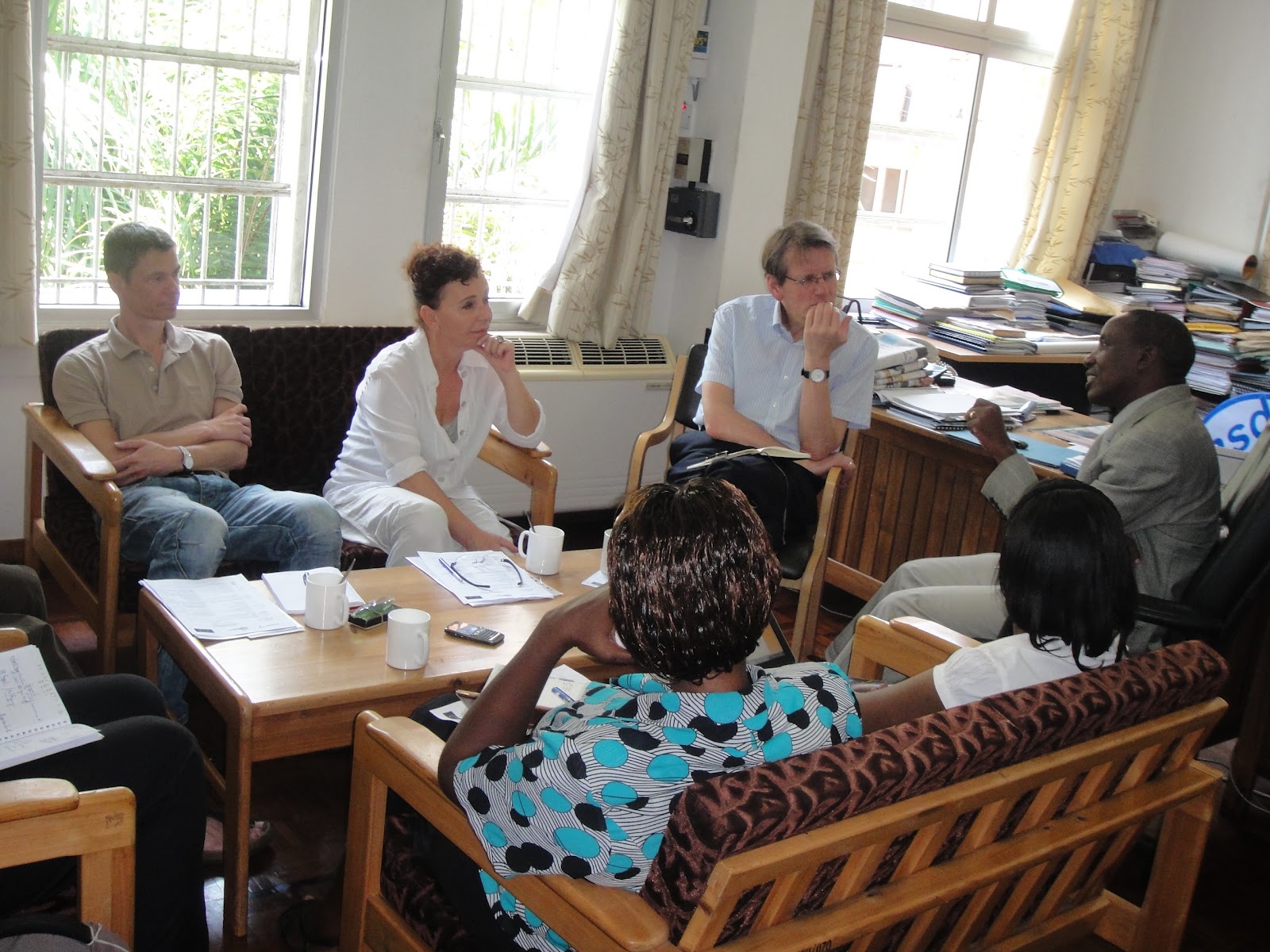
On the other hand,the Cordaid Director commended the commitment for Tanzania to organize the PBF higher Level Conference which will take place from 6th - 7th March 2012 and wished all responsible for  organizing the conference success in  their preparations.  Below is the  photo during their meeting at CSSC  Executive Directors office
 

Tuesday, January 31, 2012

The Second District PBF Forum for 2011


Rungwe PBF Pilot Project established District PBF forum in 2010 August for the aim of bringing state, church and community members in the District to discuss various issues of interest on health, whereby Performance Based Financing (PBF) which is a new Health Financing Approach in Tanzania was priority agenda.  However, the forum served a purpose of a Public Private Partnership (PPP) in the District and spearheaded discussion and signing of Service Agreement in Rungwe District.   Normally, these forums are held twice per year, at the beginning and at the end of the year.
The members of the forum are drawn from the Church leaders, local government officials, the health facilities representatives and the community representatives. 
For the year 2011, the second District PBF forum was successfully held on 13th December 2011.  It aimed at updating forum members on Rungwe PBF Pilot Project Progress and assesses the public private partnership through the signed Service Agreement between two hospitals in Rungwe (Itete and Igogwe) and Rungwe District Council.
As an update after the opening remarks, the Zonal Secretary –Fr. Lukas Komba explained briefly the new organizational set- up at the Christian Social Services Commission (CSSC) and welcomed Director of Technical Support Services from Christian Social Services Commission (CSSC) - Mr. Michael Angulile who brought greetings from the Head office and expressed about the coming of the new Executive Director Mr. Peter Maduki who took over from Dr. Adeline Kimambo who finished her contract.
 Thereafter, the Chairperson for the Southern Zone- Rt. Rev. Bishop Israel- Peter Mwakyolile informed the members that the Zonal Secretary- Fr. Lukas Komba is called by his Bishop and he will leave in January 2012. On behalf of the Southern Zone he thanked him for his hard work and commitment to make the South Zone amongst the best Zones. Additionally, he acknowledged the great contribution of Ms. Helga Schneider- who was the Technical Advisor for the Southern Zone and who finished her contract in October 2011. He finally acknowledged the good job of the outgoing Executive Director and congratulated the new Executive Director for his appointment.
There were basically two presentations.  The first presentation was done by Zonal PBF Coordinator- Mr.Sule, T.Michael on PBF Forum updates.  The second presentation was on: Public Private Partnership- A process with both Ups & Down. By Mr. Michael Angulile- Director for Technical Support Services from Christian Social Services Commission ( CSSC).
On Updates, the presentation indicated activities realized since last forum held in May 2011: Finalizing Strategic and Operational Plans for 6 health facilities, Costing of 4 Health facilities out of 12 and Negotiations for Service Agreement Signing between two hospitals with Rungwe District Council.  Other activities were Coordination of Training of 20 Health Staff by Kilimanjaro Christian Medical Centre (KCMC), and Christian Social Services Commission (CSSC) for Government and Voluntary Faith Based Organization (FBO) facilities in Sept 2011. Moreover, the Service Agreement was signed between Igogwe and Itete hospitals with Rungwe District Council in October 2011, participation in Mid- Term Review for PBF Pilot Project done in November 2011 for Zambia for Churches Health Association of Zambia (CHAZ) implementing PBF, Participation in PBF Multi-country Network Steering Committee meeting Kigali- November 2011, Re-training of Facility FGC’s in 12 Health Facilities November 2011, and Sharing PBF Information to Zonal Policy Forum (ZPF) Members in Lindi  in November 2011,finally, managing the PBF Rungwe Pilot blog with below address http://pbf-rungwe.blogspot.com/, for information sharing and dissemination within the multi-Country network. The blog is serving as the window for Rungwe PBF Pilot Project.
On the other hand, the Challenges Experienced in the project were pointed out being: Process of Signing Service Agreement with the Local Government Authorities is time consuming and complex and the delay in fund Disbursement for Service Agreement to Health facilities and Change of Policy on Consolidated Council health Plans (CCHP), which brought big change in the project set up especially on fund for purchasing of indicators.
On the other hand, the second Presentation focused on Public Private Partnerships
Overview; on General information on Public Private Partnership, the rationale for Public Private Partnership, Some positive results of Public Private Partnership, emerging discrepancies of Public Private Partnership and Lesson learnt.  It was noted that with time the partnership is improving to the extent that we have platform to discuss issues and agree jointly on ways to make them better.  This appears as small but has significant contribution in the public Private Partnership as manifested by the Rungwe PBF Pilot Project which managed to bring in important stakeholders in health to discuss matters of interest.
Thereafter, very objective discussions followed which assessed the Service Agreement which was just signed in Rungwe.  It was learnt that the hindrance for smooth Service agreement was delay of fund disbursement which was above the District Council to deal with at the point of time.  That means, it is a problem at the Central level.
As a way forward, the forum members concluded that: first, the Church leaders should have regular meetings  with the Government leaders to address staff exodus from Church health facilities to government health facilities and establish modalities to manage that, so that church facilities remain with qualified health staff. Secondly, the government should fulfill her obligation, which in the context of Public Private Partnership (PPP) is to financially support Church Health facilities that Sign Service Agreement. See the Photo of Rungwe PBF District Forum Proceedings.
 

Friday, January 20, 2012

Facility Governing Committees (FGCs) Re-training

The year 2011 was one of the hectic and successful in Rungwe PBF Pilot Project Implementation.  It was basically featured with a lot of works and events which are worth noting.  One of the important event was re-training of the Facility Governing Committees (FGC’s) members from 12 health facilities under Rungwe PBF Pilot Project. Their main function is to strengthen the clients Voice in health care Provision in the health facilities apart from other functions. The activity took three days in total from 6th- 8th December 2011, and was done in three clusters by Rungwe PBF Pilot Project Team.
The Objective of the Training was to enhance the capacity of the facility Governing Committee (FGC’s) members in management of the health facilities by making concrete their roles and responsibilities. Thus, there were two presentations made by Zonal PBF Coordinator: The Roles and Responsibilities of Facility Governing Committees and the second presentation focused on the general information on Rungwe PBF Pilot Project.
The training was conducted in three clusters based on geographical location of the health facilities. Cluster one was Tukuyu which had these facilities: Igogwe Hospital, Tukuyu Health Centre, Kisa Health Centre, Rungwe Mission Dispensary and Kalebela Dispensary. Cluster two was Mwakaleli and composed of three health facilities namely: Mwakaleli, Mbigili and Mpata Dispensaries.  The third Cluster was Itete with four facilities: Itete hospital, Ntaba Dispensary, Manow Dispensary and Kasyabone Dispensary.
Generally, the participation was good. On 6th December 2011 at Tukuyu Cluster (56%) attended the session. It was followed by training on 7th December 2011, at Mwakaleli Cluster and the participation was (82%), and lastly, on 8th December 2011, at Itete Cluster the attendance was (80.9 %).
Additionally, the training was used as a feedback session for the facility Governing Committee members on how they performed their roles and responsibilities and the challenges they encountered in playing their roles. It was clear they play a linking role between the clients and the facility management.  The training enabled members to see their roles in concrete terms and they eventually promised to work hand in hand with the facilities management teams  to improve the health facilities conditions for the benefit of the community.
Being an adult learning, the facilitator employed participatory methodology- thus it was brief presentation and followed by discussions and Comments.  As the results, the participants made number of comments regarding improving the health facilities.  The outstanding ones being: health facilities to recruit the retired Medical Personnel to curb the acute human resource gaps experienced. Another comment  was to orient the facility Governing members on  the Strategic and Operational Plans and use the plans. Lastly, the in charges to contact the District Medical Officer (DMO) for the remuneration of the Facility Governing Committees (FGC’s)members when they meet as part of their motivation.  Currently, most of the health facilities are facing financial constraints to the extent of failing calling meetings according to schedules which is on quarterly basis.
In a nutshell, the re-training of the Facility Governing Committee members managed to achieve the set objective. It is anticipated that they will link the community and health facilities, and in so doing the client’s voice be strengthened, which will lead to improve health services provision in the health facilities they represent.
See Group Photo of the Participants after training Session at Mwakaleli Cluster.

Monday, January 16, 2012

The Bishops and Chairpersons briefed on Performance Based Financing.


The Zonal Coordinator for Rungwe Performance Based Financing was invited by the CSSC Zonal Secretary to make a presentation on Performance Based Financing to Zonal Policy Forum members-(who are Bishops and Chairpersons).  The meeting was held in Lindi (which is Southern Tanzania) on 30th November 2011. The aim of the presentation was advocacy for Performance Based Financing in Health Care provision in the Southern Zone. The forum members were composed of:  Bishops and Church Chairpersons from the Southern Zone apart from the officials from Christian Social Services Commission (CSSC) and a total of 28 Leaders attended this meeting.
The Presentation was focus on general information on Performance Based Financing as new approach in health care in Tanzania, project information (objectives, expected Results, stakeholders, principles), and updates of project progress, the challenges and proposed solutions.
After the presentation, the members were mainly concerned with challenges which mainly were on the issue of policy change on Comprehensive Council Consolidated Health Plans (CCHP), based on this presentation and others by RMO Lindi Presentation on Public Private Partnership, whereby he also noted that.  Unfortunately, this change has affected financing of Performance Based Financing.
As a way forward, the members anonymously declared that they will organize a forum in which they would call the Minister for Health and Social Welfare to practically discuss ways of improving conditions in the Voluntary Agencies Hospitals (VAHS).  Suggested improvement included: The Government to provide Drugs, Medical Supplies and pay the salaries for the qualified staff.  That was discussed in line with the general trend on Service Agreement which needs more improvement on financing part.  Below is the Group Photo of the Participants after the official opening.